
“Off with their Heads!”

This morning, I’m thinking about a portion of one of the President’s many executive orders, which has not received as much attention as it deserves. Executive Order 14215 Ensuring Accountability for All Agencies was signed on February 18, 2025. It is a direct expression of the philosophy of the Heritage Foundation as expressed in Project 2025, published in 2023, and intended to guide the next Republican administration. The key leaders of this project were Kevin Roberts, President of the Foundation, and Russell Vought, who wrote the chapter on the executive powers of the Presidency.
To me, the most concerning part of EO 14215 is the section that abolishes independent legal judgment within the government. Here is a portion of the text:
“The President and the Attorney General’s opinions on questions of law are controlling on all employees in the conduct of their official duties. No employee of the executive branch acting in their official capacity may advance an interpretation of the law as the position of the United States that contravenes the President or the Attorney General’s opinion on a matter of law.”
This is breathtaking in its scope. All lawyers in the executive branch, from the Justice Department and the Office of Legal Counsel down to the general counsel of every independent agency, as well as lawyers who act as Inspectors General and Judge Advocate General military officers, are now prohibited from exercising independent legal judgment. Their professional obligation to follow the law is superseded by their obligation to follow the President’s interpretation of it.
Historically, the Justice Department and the FBI have jealously guarded their independence from the White House, following constitutional principles and professional ethics. The norm held even under strain. Attorney General Gonzales and AG Mukasey both served under pressure from the Bush White House, yet separation remained a stated value even when it was imperfectly observed. Bill Barr, Trump’s own Attorney General in his first term, took pains, however unconvincingly, to avoid the appearance of being the President’s personal lawyer. The uproar when President Clinton walked across a Phoenix tarmac to chat with AG Loretta Lynch in 2016 showed how seriously the public took even the appearance of political contamination. FBI Director Comey refused to pledge personal loyalty to Trump.
Within the Justice Department, the Office of Legal Counsel is charged with providing legal advice to the President and executive branch agencies, and it plays a special role in preserving the separation of powers. The intent, aspirational though often imperfectly realized, was that OLC functioned as something like an independent legal conscience for the executive branch.
This is no more. The President alone is now the sole authority on legal matters within the Executive Branch and all of its agencies, including those nominally independent. He can impose his interpretation of the law on any domain: labor rights, campaign finance, securities regulation, the military, financial markets, consumer financial protection, telecommunications, the internet, antitrust, energy markets, and nuclear safety. No corner of American regulatory life is exempt.
Does this executive order mean that the President can direct or engineer the execution of a political opponent? The answer is almost certainly no, because our constitutional machinery still requires a federal prosecution, a jury, a judge, and appellate review. But it moves us in that direction. Under EO 14215, the President does controls who gets charged with federal capital and other crimes, whether prosecutors seek death, and what legal arguments government lawyers may make in court. The decision about whose crime is “of a severity demanding” the death penalty now belongs to one man.
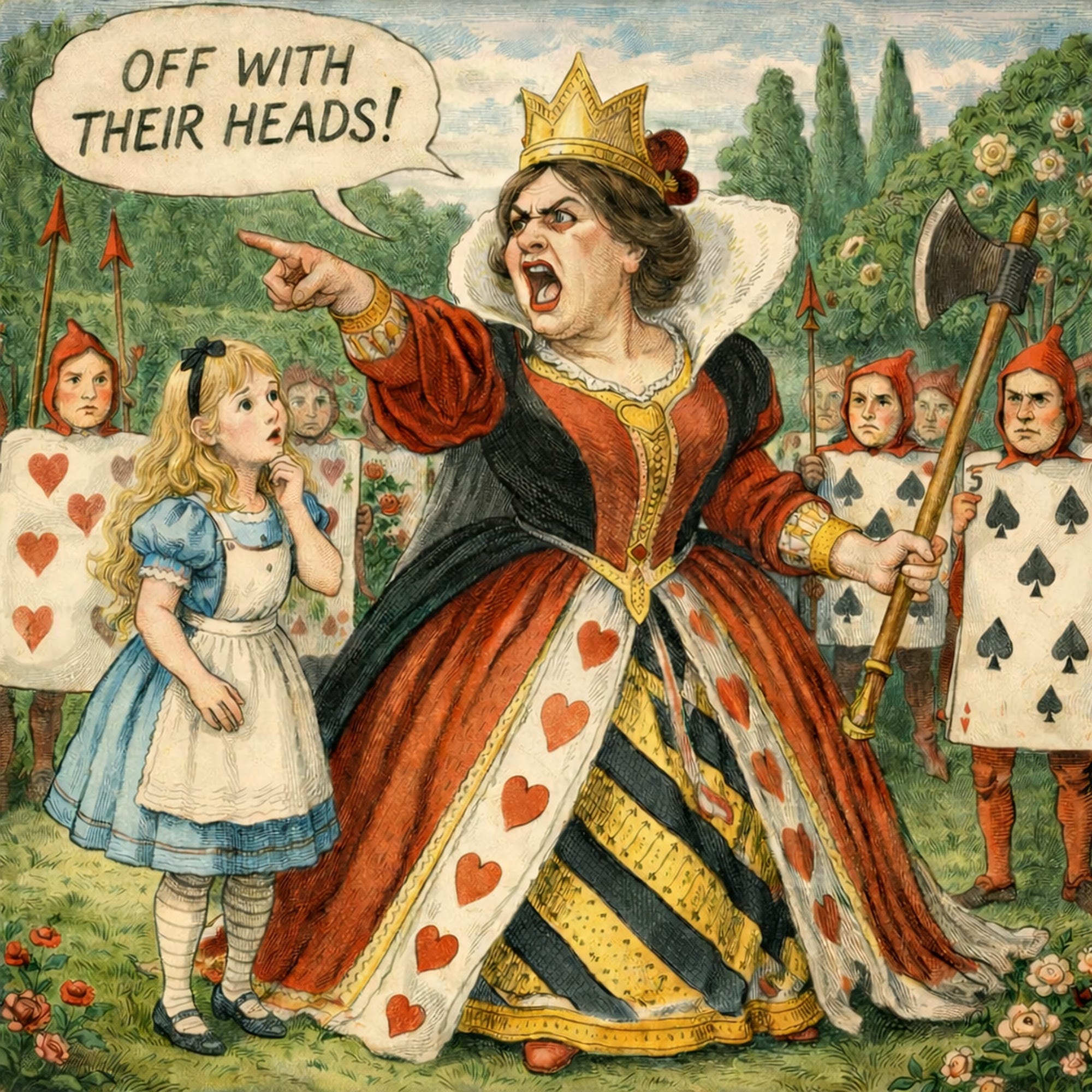
Writing this, I can’t help but remember Lewis Carroll’s the Queen of Hearts, commanding, “Off with their Heads! Off with their Heads!” in Alice’s Adventures in Wonderland.
Any person charged with a federal crime will find that they suddenly have no time for anything else. Their legal expenses will become astronomical. Their reputation may be destroyed before a single charge is proven, and they may become unemployable. Do we think it is a good idea to give one person the power to initiate and control these legal mechanisms?
In the view of most mainstream constitutional scholars, EO 14215 is almost certainly illegal. However, until it gets to the Supreme Court (where the current Court’s sympathies toward executive power make the outcome uncertain) or until some lower court intervenes, our present government can proceed as it desires, making this executive order de facto law.
In addition, lawyers throughout the executive branch now know, formally and in writing, that advancing a legal interpretation their agency expertise supports but that the President disagrees with is a prohibited act.
We are approaching a rule by law government, defined as one where a single authority determines and enforces the law according to his/her own will. The executive order moves us sharply in that direction. It makes all government lawyers, including those at the Justice Department and the Office of Legal Counsel, vassals of the President rather than what they are supposed to be: officers of the court. It is the opposite of rule of law.
We can define an officer of the court as:
“Any person who has an obligation to promote justice and uphold the law . . . an attorney owes duties to a court separate from the duties owed to the attorney’s client.” (LII, Cornell Law School)
That independence is not a technicality. It is the mechanism by which the rule of law is maintained in practice, every day, in every courtroom.
The rule of law holds that no person is above the law. Not even a President. “Equal Justice Under Law” is carved into the Supreme Court pediment. The Encyclopedia Britannica defines rule of law as the mechanism that “supports the equality of all citizens before the law, secures a nonarbitrary form of government, and more generally prevents the arbitrary use of power.” The President’s executive order is a direct assault on this concept.
Humpty Dumpty, in Through the Looking Glass, explains his philosophy to Alice:
“When I use a word, it means just what I choose it to mean, neither more nor less. The question is which is to be Master, that’s all.”
Lewis Carroll was writing fantasy. The question of who is to be “Master” is not. In a rule of law democracy, that question belongs to all of us. Executive Order 14215 reveals President Trump’s desire for unchallenged power.
Also - the courts move so slowly that action is taken and finished before the courts can catch up. It is concerning to think of the possibility - that you raise - of a political execution. This may not be legal, even in the current climate, but it could happen before the legal system could act.
Your essay is a perfect description of the current administration, and we will pay dearly during its era. I have contacted Congressmen and your comments should be read in Washington.Jim Hawley