
Wind Power Facts

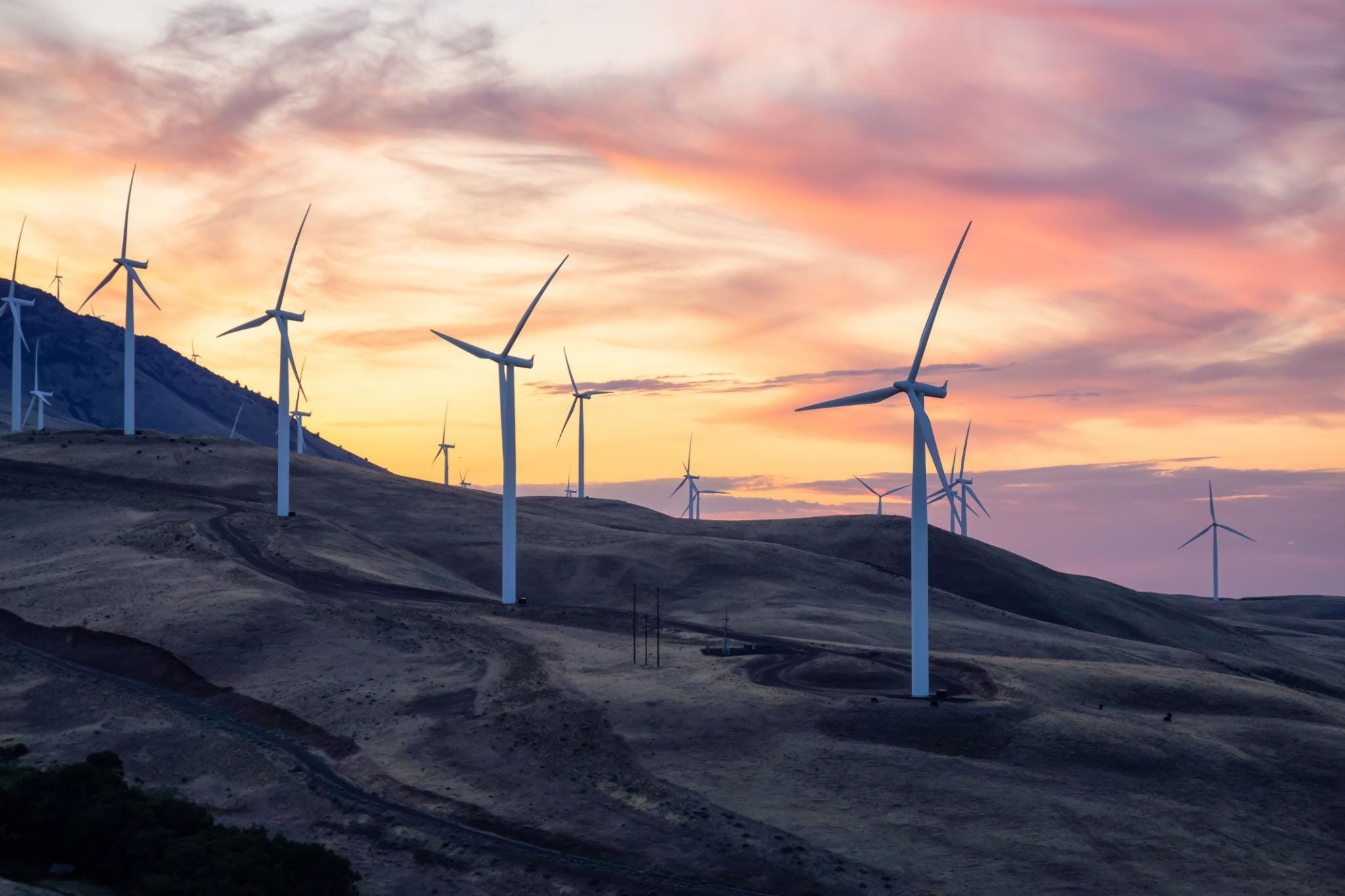
Back in February, I wrote a piece titled “Immigration Facts” to provide clear information about that subject, particularly because our own government was releasing so much misleading and sometimes outright false data. This is an attempt to do the same for wind power, where government officials are also circulating misleading claims. The facts about the costs of power generation have changed significantly over the past few years.
Utility scale wind and solar power are now the cheapest sources of new electricity in America. As the years go by, it is likely that other low-cost sources, some as yet unenvisioned, will be developed or invented.
Right now, my eyes are a little bleary from looking at data and charts, but I may research and write another note, exploring the facts about solar energy and looking at prospective new technologies.
1. Wind and Solar are the cheapest sources of new electricity in America.
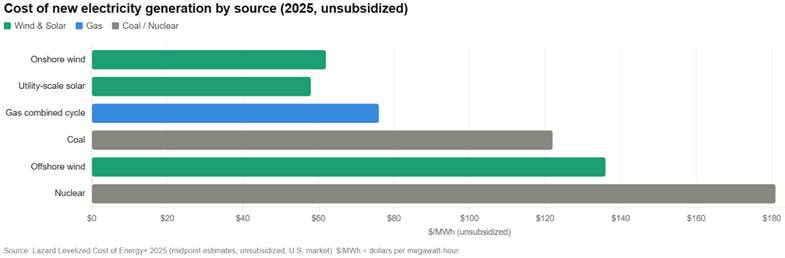
The relevant question for America’s energy future is not what it costs to run a plant built decades ago, but what it costs to build new generating capacity today. Lazard, the investment bank that produces the most widely cited annual energy cost analysis, concluded in its 2025 report that utility-scale onshore wind and solar have been the most cost-effective forms of new-build electricity generation on an unsubsidized basis for ten consecutive years. Onshore means wind generated by land-based wind turbines as contrasted with turbines located in the oceans.
Onshore wind comes in at $37–$86 per megawatt-hour, cheaper than coal, cheaper than new gas, and far below current estimates for new nuclear construction. These numbers do include the cost of end-of-life decommissioning. No single metric captures every grid cost, but on a straight new-build generation basis, onshore wind and solar energy are currently the lowest-cost large-scale sources of electricity in much of the United States. Oil-fired generation now accounts for less than half a percent of U.S. electricity:
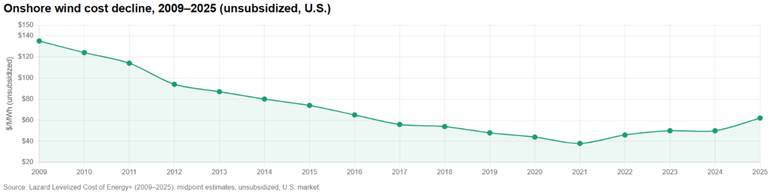
2. Onshore wind costs have fallen 72% since 2009.
In 2009, generating a megawatt-hour of electricity from onshore wind cost $135. By 2021 that had fallen to a low of $38, a 72% reduction driven by technological improvements, larger turbines, and economies of scale. Costs have risen modestly since 2021 due to supply chain pressures (tariffs) and higher interest rates, but onshore wind remains cheaper than any fossil fuel alternative for new construction. The Department of Energy’s target is $27 per megawatt-hour by 2035, a further 30% reduction.
3. Offshore wind is more expensive, but costs are coming down.
Offshore wind is sometimes conflated with onshore wind to make the case against wind power generally. They are not the same thing. Offshore wind currently costs roughly $136 per megawatt-hour, because turbines must be installed at sea using specialized vessels, foundations must withstand ocean conditions, undersea cables connect them to shore, and maintenance requires specialized equipment. Construction costs offshore run nearly three times those of onshore installations. That said, industry sources forecast offshore wind costs will fall to around $53 per megawatt-hour by 2035, below the cost of a new natural gas plant, as the industry scales and supply chains mature. Government subsidies were designed to foster and hasten this process.
Offshore wind is close to each coast and, accordingly, will need shorter transmission lines to reach population centers.
4. A note on natural gas.
Critics correctly point out that electricity from existing natural gas plants is currently cost-competitive, gas prices are low, and plants that have already been built and paid for can generate electricity cheaply. But this is only half the picture. According to Lazard, the cost of building a new combined cycle gas turbine has reached a ten-year high, driven by turbine shortages, rising construction costs and long delivery times. A new combined cycle gas turbine comes in at approximately $60–$90 per megawatt-hour, with a midpoint of around $76 per megawatt-hour. On a new-build basis, wind remains cheaper.
5. Transmission Lines.
The standard cost comparisons used by Lazard, National Renewable Energy Laboratory (NREL), and the U.S. Energy Information Administration include local grid connection costs but not the full expense of long-distance transmission infrastructure needed to move wind power from where it is generated, largely the Great Plains and the mountain West, to where most Americans actually live, largely the coasts.
Two things are also true, however. First, natural gas has its own infrastructure costs, pipelines, compressor stations, storage facilities, that are similarly excluded from standard cost comparisons. Second, the transmission buildout required for a renewable-heavy grid, while genuinely large, is a one-time capital investment with a compelling economic logic: wind and solar, once built, require no fuel. The sun and the wind are free. Every megawatt-hour generated by a wind turbine or a solar panel is a megawatt-hour that does not require purchasing coal, gas, or oil. A gas plant, however efficient, also remains permanently exposed to the supply and price of gas. Over the twenty-to-thirty-year life of a wind farm, it is immune to price spikes, supply disruptions, and geopolitical instability.
NREL’s modeling suggests that achieving 80% zero-carbon electricity by 2030 would require wind and solar combined to reach between 60 and 75% of the U.S. electricity mix, supplemented by nuclear, geothermal, and hydropower for around-the-clock reliability. The future of American electricity is a portfolio, not a single source.
The transmission infrastructure required to deliver that power at scale is the largest single challenge in the transition. Transmission infrastructure alone is estimated to require $300 to $500 billion in new investment, roughly $25 to $40 billion per year over twelve years, comparable to annual U.S. highway spending.
The return on that investment is substantial. NREL’s National Transmission Planning Study found that better transmission connections allow electricity to flow from wherever it is cheapest to generate, windy plains, sunny deserts, to wherever it is needed, reducing the total cost of running the American electricity system by $270 to $490 billion through 2050. The transmission lines very nearly pay for themselves before counting a dollar of avoided fossil fuel costs. When the avoided costs of climate change damage are factored in, NREL calculates an overall net benefit to society ranging from $920 billion to $1.2 trillion.
6. Wind power is already carrying an increasing share of the American grid.
Nobel Prize-winning economist Paul Krugman writes that renewables, mostly wind, but with a growing role for solar, “now account for more than a third of electricity generation in Texas, America’s largest producer of electricity and not exactly a state run by environmental extremists.” Iowa gets 65% of its electricity from wind. Denmark gets 56% of its electricity from wind. At least nine other European countries, plus Uruguay, now generate more than a quarter of their electricity from wind. Large-scale reliance on wind power is not a future aspiration; it is an existing reality in a growing number of places.
Within the US, wind power generated 464,000 gigawatt-hours of electricity in 2025, accounting for approximately 10.5% of total U.S. electricity generation. Wind remains the single largest renewable source, ahead of solar. Wind and solar combined reached 17% of U.S. electricity generation in 2025, up from less than 1% in 2005. That is a remarkable twenty-year trajectory as shown in the chart below:
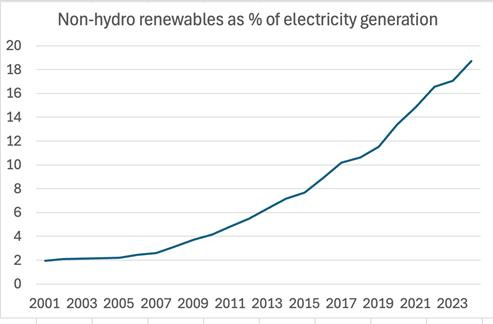
Chart from Professor Paul Krugman
In 2024, wind and solar together surpassed coal in total U.S. electricity generation for the first time. Coal had dropped to 15% while wind and solar reached 17%. Just six years earlier, in 2018, coal was three times larger than wind and solar combined.
7. The wind does not always blow, but the grid has never relied on any single source.
This is the most common objection to wind power. Wind is variable; it produces more power at some times than others. Expanded transmission infrastructure does allow regions with excess wind generation to support areas experiencing lower output. But the American electricity grid has never relied on any single source. Natural gas plants go offline for maintenance. Nuclear plants shut down unexpectedly. Coal plants in Texas failed catastrophically due to severe winter weather in February 2021. Grid operators have always managed variability, and grid modernization continues to improve system stability and balancing capacity.
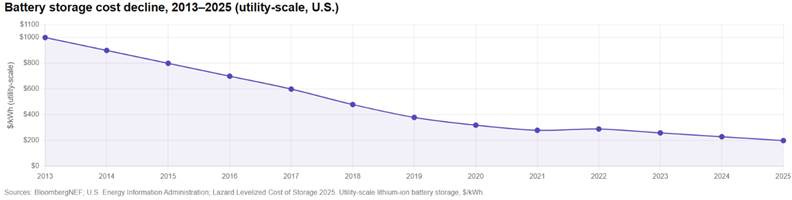
The answer to wind’s intermittency is battery storage, and it is arriving faster than almost anyone predicted. U.S. battery storage capacity increased 66% in 2024, and costs have fallen 80% over the past decade. In 2025 alone, developers added 15 gigawatts of new battery storage to the U.S. grid, a record, and 24 gigawatts more are planned for 2026. The result is measurable: in summer 2025, the Texas grid projected the risk of a power outage at just 0.5%, compared to a 16% risk the previous summer.
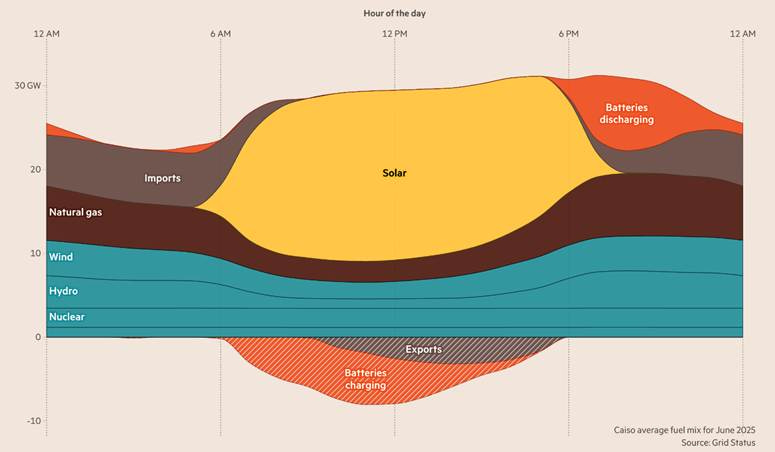
Here is a chart and some text taken from one of Professor Krugman’s posts showing how batteries can help balance energy sources. “California now relies on solar for much of its electricity. Here’s what an average day in June looked like:”
8. Wind and Solar are creating fast-growing, well-paying jobs across the country.
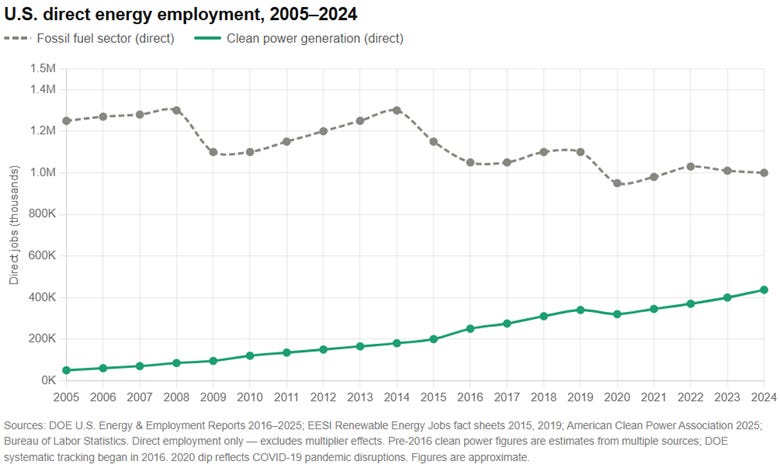
The fossil fuel industry sometimes claims as many as 9.8 million jobs by counting gas station attendants, convenience store clerks, and other downstream workers through broad multiplier effects. The fair comparison uses direct employment, and on that basis, the U.S. Department of Energy’s 2025 Energy and Employment Report counted approximately 1 million workers directly employed across the entire U.S. fuels sector, including oil, gas, and coal extraction, refining, and distribution.
In contrast, the clean power industry directly employs 437,000 Americans, and that number is among the fastest-growing in the American economy. The Institute for Energy Economics and Financial Analysis found that the U.S. oil and gas industry employs 20% fewer workers today than it did a decade ago, as productivity gains mean more oil with fewer people. (Coal mining directly employs only roughly 40,000 workers nationally.) Here is a 20-year comparison:
Meanwhile, the Bureau of Labor Statistics projects wind turbine service technician and solar photovoltaic installer to be two of the fastest-growing occupations in America through 2034, with double or triple-digit percentage growth. The jobs also pay well, and slightly better than fossil fuel work. According to E2, a nonpartisan business group, jobs in coal, natural gas and petroleum pay $24.37 an hour on average, while solar and wind jobs pay a median of $24.85 an hour, with wind and grid modernization jobs averaging more than $25 an hour.
Unlike fossil fuel extraction jobs, which are concentrated in a handful of states and geologically determined, clean energy jobs are available in every state in the country, and 79% of installed clean power capacity is located in districts represented by Republicans.
9. Caveats.
Wind turbines are ugly and spoil views. Communities closest to turbines indeed tend to become more accepting over time as familiarity grows. Property values may be affected. The most comprehensive U.S. study, published in the Proceedings of the National Academy of Sciences in 2024, analyzed more than 300 million home sales and 60,000 wind turbines over twenty years. It found a modest 1% drop in home values within a turbine’s viewshed, but crucially, the effect was no longer detectable by the end of the twenty-year study period.
Turbines do kill birds. The turbines I’ve seen turn so slowly that it is difficult to see why they would be lethal. But the U.S. Fish and Wildlife Service estimates approximately 234,000 birds are killed per year. That number is real and worth taking seriously, particularly for raptors and other slow-breeding species that cannot quickly recover from population losses. However, context matters. The same Fish and Wildlife Service estimates that cats kill an average of 2.4 billion birds per year in the United States, building glass kills 599 million, and vehicles kill around 214 million.
A 2012 peer-reviewed study in Energy Policy found that wind projects kill 0.269 birds per gigawatt-hour of electricity produced, compared to 5.18 birds per gigawatt-hour from fossil fuel projects, nearly twenty times as many, when full lifecycle impacts including habitat destruction, acid rain, and climate change are counted.
The wind industry is also making real progress: AI-assisted radar systems can now detect approaching birds and automatically shut down individual turbines. A large-scale project in Spain reduced raptor mortality by more than 60% while cutting energy production by less than 1%.
Turbines are noisy. Modern turbines do produce low-frequency noise, which can be a legitimate concern for residents living very close to them. This can be addressed through setback requirements.
Wind power requires rare earth minerals and has its own supply chain costs. Wind turbine generators use rare earth elements, and their mining and processing carry environmental costs. Turbine blades, made of fiberglass composites, are currently difficult to recycle, and a significant number end up in landfills.
10. China and other countries have taken the technical and production lead from the US.
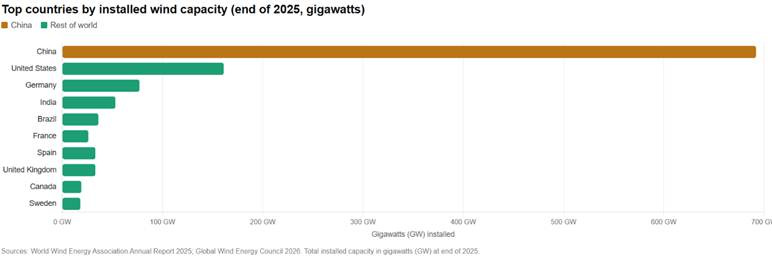
While debate continues in the United States, the global wind industry installed a record 165 gigawatts of new capacity in 2025, up 40% from 2024. China alone added 130 gigawatts in a single year, accounting for 77% of the global market, and now holds more than half of the world’s total installed wind capacity. At its current pace, China is on course to reach one million megawatts of wind capacity by 2027 or 2028, more than six times the entire U.S. wind fleet today. India set a national record of 6.3 gigawatts in 2025. Seven European countries each added more than one gigawatt. Vietnam’s wind capacity grew by more than 50% in a single year.
The World Wind Energy Association observed bluntly that while U.S. federal policy has become more ambivalent toward renewable energy, China has become the technical and manufacturing leader. Global wind capacity is now on course to exceed two terawatts by 2030. As Professor Krugman noted, the wind and the sun “don’t need to transit the Strait of Hormuz,” a fact that energy-hungry nations around the world have clearly internalized.
11. The AI revolution runs on electricity, and the industry is turning to renewable sources.
Artificial intelligence is driving an electricity demand surge unlike anything in recent history. According to the International Energy Agency, electricity demand from data centers soared 17% in 2025, far outpacing overall global electricity demand growth of 3%, and is projected to more than double by 2030. The companies building this infrastructure are not waiting for the policy debate to resolve itself. Since the beginning of 2025, leading AI companies have signed at least a dozen large renewable energy contracts, each adding more than 100 megawatts of capacity. Microsoft’s data center in Wyoming is powered entirely by wind. Google purchases wind power for its data centers in Belgium.
AI companies are also investing in nuclear power, so the realistic picture for AI power needs is a mix of wind and solar backed by nuclear and gas for 24/7 reliability.
Companies that understand the economics of the future, and whose entire business model depends on affordable, reliable electricity, are voting with their capital for wind and solar as their primary power source.
Summary
Wind power is not a distant promise or a political preference. It is the cheapest source of new electricity available today, already powering a third of Texas, nearly two-thirds of Iowa, and more than half of Denmark. Its costs have fallen 72% in fifteen years and are still falling.
Together, wind and solar, paired with storage and grid modernization, are rapidly becoming the dominant sources of new electricity generation worldwide, cheaper, cleaner, and increasingly more reliable than the fossil fuel alternatives they are replacing.
Sources: Lazard Levelized Cost of Energy+ 2025; NREL Annual Technology Baseline 2024; NREL Cost of Wind Energy Review 2024; U.S. Energy Information Administration; International Energy Agency; International Renewable Energy Agency; World Wind Energy Association Annual Report 2025; Global Wind Energy Council 2026; American Clean Power Association 2025; U.S. Department of Energy Energy and Employment Report 2025; Institute for Energy Economics and Financial Analysis 2025; E2 Clean Jobs Report; Bureau of Labor Statistics; BloombergNEF; Dallas Federal Reserve; Paul Krugman, Substack. Charts generated by AI. NREL National Transmission Planning Study 2024; Proceedings of the National Academy of Sciences 2024 (property values study); and Energy Policy journal 2012 (Sovacool bird mortality study).
It is interesting to note that the energy alternatives that the current US administration has been at odds with, have gained a resurgence in the global community due to the US/Israel-Iran war, due to supply fragility of petroleum energy. The move towards green energy in this instance is motivated by supply and economics rather than climate considerations, but it is an unintended silver lining none-the-less.
The cost of wind electricity is only less if the cost of the required backup system is ignored. Every jurisdiction that has built wind energy has the highest electricity costs. The charts are not wrong. Wind electricity cannot build anything. We need oil to build everything we want. We cannot grow food without oil.
The tip speeds of wind turbines are on the order of 300 miles per hour. Birds cannot survive the turbine tips at these speeds.
AI's electricity needs are driving the development of nuclear fission energy. This is the safest way to generate large quantities of reliable electricity.
This article is not based on current science.
Best regards,
H. Douglas Lightfoot
hdouglaslightfoot@gmail.com